
How fast do Gulf Coast car dealers respond to internet leads? We tested 12.
Most businesses don't have a lead problem. They have a follow-up problem. This summer I measured what that actually looks like on the Gulf Coast, one store at a time.
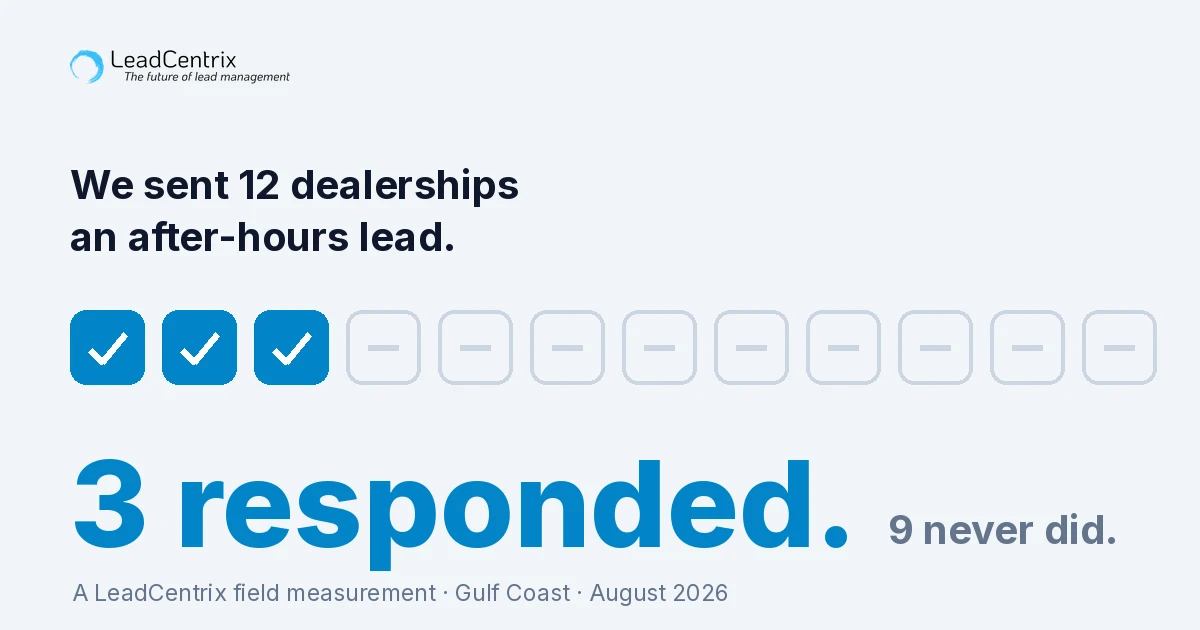
The study, in one paragraph. Over five weeks in July and August 2026 I inquired after hours at 12 dealerships across the Florida Panhandle and lower Alabama, posing as an ordinary used-truck buyer, by phone, website form and chat, one inquiry per store, and logged every response to the minute. Three of the nine stores I probed by phone had no way to leave a voicemail at all. I also tried two website inquiry forms after hours; neither worked as intended. Of the twelve stores, three responded with a human inside 72 hours, and all three did it the same way: first thing the next business morning, ten to twelve hours after a late-night inquiry. One store followed up nine times in seven days. Most never called once. This is a small regional sample, one inquiry per store, so it measures what a single after-hours shopper experiences, not any store's overall performance.
What the national numbers claim
Search this topic and you'll meet the famous five-minute rule: respond inside five minutes or your odds of reaching the lead collapse. The stat traces to a 2007 Harvard Business Review lead-response study, and here's something odd I found while reading every page that ranks for this question: the same study gets quoted as 10x on one site, 21x on another and 100x on a third. Nobody went back to the source.
The "average dealer response time" is in worse shape. Published figures on the first page of Google run from 18 minutes to 47 hours. That's not a range, that's a shrug. The one measurement house that actually tests stores, Pied Piper's annual mystery-shop study, reported in 2026 that about half of dealers manage a quality response inside 15 minutes nationally.
None of those numbers are wrong, exactly. They're just national, brand-level and recycled. Nobody had measured our region, store by store, channel by channel. So I did.
What actually happened, store by store
Every inquiry went in after closing time, the way a real shopper browses at 10 PM with a truck on their mind. Every store got a name, a callback number and a specific vehicle from its own website.
| Channel | Tried | Worked | What happened |
|---|---|---|---|
| Sales line (phone) | 9 stores | 6 of 9 | Three stores had no voicemail path at all: one phone menu looped back to the attendant for two minutes, one line rang out to a busy signal, one had no after-hours box. A caller there leaves no trace. From the store's side, the call never existed. |
| Website inquiry form | 2 stores | 0 of 2 as intended | One form showed "we received your information" and a failure notice on the same submission. The other rejected the first attempt with an error and only accepted a corrected resubmission. A buyer who walks away at the first error is gone. |
| Website chat | 4 stores | 4 accepted | The only channel that took every inquiry cleanly. Two of the three responses in this study started as chat inquiries. |
Two findings deserve their own sentences.
First: before you can be slow, the lead has to arrive. The industry argues about five minutes versus thirty. At a third of the stores I called, the argument is moot, because an after-hours phone lead cannot leave a message at all. I've started calling this intake integrity: does each door into your store actually open? No one on page one of Google tests it. It's cheaper to fix than any speed problem, and it comes first.
Second: the best follow-up I measured was genuinely excellent. One store's team answered a late-night chat inquiry by 9:32 the next morning and then worked that silent lead nine times in seven days, calls, texts and voicemails, without one reply from me. That's not a lazy industry. That's a capable team pointed at whichever leads make it through the door.
What happens after the first response?
Mostly, nothing, because there is no first response. Nine of the twelve stores hadn't responded by the 72-hour mark. And the three that did respond show the whole spectrum of what happens next: one made a single burst of contact the next morning, a text, a call and a voicemail inside an hour, and never tried again; one made two attempts; one chased for a week.
And here's the part that should interest a dealer more than any five-minute debate: the follow-up that does happen has a short life. Even the nine-touch store, the best in my sample by a mile, will file that lead away eventually. Every store does. Nobody chases for six months, and nobody should.
That's the quiet arithmetic behind every CRM in the region. The leads that got no response, the leads whose voicemail vanished, the leads the chase gave up on after a week: they settle to the bottom of the database, still holding a name, a number and a vehicle of interest. Some of those people bought elsewhere. Some are still shopping. The store already paid to acquire every one of them.
Five things to check at your store this week
None of this needs new software. It needs a phone and ten minutes after close.
- Call your own sales line at 10 PM. Can you actually leave a message, or does the menu loop?
- Submit your own website form and watch what the customer sees. One store's form claimed success and failure on the same screen.
- Send a chat inquiry and time the response to the minute.
- Ask who owns after-hours leads by name, not by department. A department mailbox is where messages go to age.
- Pull ten leads from 90 days ago and check the last activity date on each. That number is your real follow-up window.
If those checks come back clean, your intake is healthier than most of the stores I measured.
Questions dealers ask about lead response
How fast should a dealership respond to an internet lead?
During staffed hours, the published consensus says under five minutes for contact rate, and under 15 minutes puts a store in the better half of Pied Piper's national sample. For an inquiry sent after 9 PM, the fair benchmark is different: an automated acknowledgment right away, then a human first thing the next morning. The three stores in my test that responded all hit exactly that next-morning mark, and they deserve the credit. The finding isn't that anyone was slow. It's that nine of twelve never responded at all.
What is the average dealer response time?
Published national figures disagree with each other by two orders of magnitude, from 18 minutes to 47 hours, so quote none of them with confidence. What I can say from measurement: on the Gulf Coast, three stores in twelve produced any human response within 72 hours of an after-hours inquiry.
Do after-hours leads really matter?
Industry estimates put 40 to 50 percent of lead submissions outside business hours, and every inquiry in this test went in after close because that's when working buyers shop. If your after-hours channels don't work, the five-minute rule never gets its chance.
What's the cheapest fix for slow lead response?
Testing your own intake. A voicemail box that works and a form that submits cost nothing and recover leads you already paid for. Speed upgrades come after the doors open.
Does response speed matter for older leads too?
Differently. A fresh lead rewards speed; an aged lead rewards showing up at all, because nobody else is calling them anymore. Reactivating those is the work we do, and it's measured the same way this study was: receipts, timestamps, and you only pay when a deal closes.
Who ran this test and how?
John Dooley, LeadCentrix, Pensacola. One inquiry per store, after hours, real vehicles from each store's own inventory, every response logged with timestamps and screenshots. No store is named in either direction, and no store was contacted more than once. An earlier field report from this program is here.
The measurement we run next
Every number in this piece came from watching what stores do with a brand-new lead. If you want a lead management system that not only handles after-hours calls and rapid responses to your incoming leads, as discussed above, but also recovers the leads your store stopped chasing months ago, that's what LeadCentrix builds. Our LeadControl service covers the incoming side and keeps the 10 PM shopper out of the dead voicemail box. To complete the system, the aged leads should be reviewed and cleaned up first. That pile has receipts too, sitting in your CRM right now. We audit 50 of them and hand you the breakdown. Nothing gets sent to your customers, and you keep the numbers either way.
Sources: Oldroyd, McElheran and Elkington, "The Short Life of Online Sales Leads," Harvard Business Review (study 2007, published 2011). Pied Piper PSI Internet Lead Effectiveness Study (2026). LeadCentrix Gulf Coast field measurements, July and August 2026; methodology summarized above. Regional findings are one measurement per store and are reported as what happened, not as a statistical study.
If your CRM has leads nobody has worked in months
We'll check fifty of them free. Pick any month at least 90 days back and send the first fifty internet leads from it — one date filter, so neither side gets to cherry-pick. You get back a record-by-record breakdown: which are workable, which we'd set aside, and the reason sitting next to each one.
No agreement to sign. We never log into your system. The breakdown is yours whether you work with us or not.
Or just call — (850) 495-7561, ask for John.